
Welcome to GolfLic.com, Golf Lessons In A Can.
We took real bits of golf lesson and canned them in a golfer safe formula that is fun, safe, and effective to use.

GolfLic Golf Lessons In a Can
Tired of endless, pointless chatter from social golf influencers? Want to improve your golf game without confusing jargon and endless talk? Does watching more golf videos actually make your swing worse? GolfLic’s canned golf lessons are sure to quench your thirst for golf knowledge. Crack open a GolfLic, and improve your game with GolfLic, Golf Lessons in a Can.
Most Watched Golf Videos
The most-watched golf videos from the Jobe Leonard YouTube channel, ranked by views.





Focus Based Golf Lesson with F Machine Golf
Focus Based Golf Lesson with F Machine Golf: Training Your Attention
Here is a truth most golfers ignore: the difference between your good shots and bad shots usually is not your swing — it is your focus. This focus-based golf lesson with F Machine Golf attacks the mental side of the game, training the one skill that affects every single shot you hit: your attention.
Think about your last bad shot. Chances are your mind was somewhere else — on the last hole, the group behind you, or the water you were trying to avoid. Golf punishes divided attention more than any other sport because the ball is stationary; there is nothing forcing you to lock in except your own discipline.
How to Train Focus Like a Skill
Focus is trainable, and the method is simple: narrow your attention deliberately before every shot. Pick one small, specific target — not “the fairway” but “that dark patch of grass just left of the bunker” — and keep your eyes and mind on it through your routine. A narrow external target quiets swing thoughts better than any swing tip.
Between shots, let your mind wander freely. The best players in the world are not locked in for four hours straight — they switch focus on for the 30 seconds of the shot and off for the walk. Practice that on-off switch on the range: chat between balls, then go silent and narrow for each swing.
Your swing is probably better than your scores suggest. Train your focus, and the scores will catch up to the swing.
⛳️ Want more raw, unfiltered golf? Browse the full Shankers Blog — every shot, every round, no fluff.

Why Does This Birdie Putt Miss?
Why Does This Birdie Putt Miss? The Real Reasons
It’s the most painful question in golf: why did that birdie putt miss? The video above asks it honestly — and the answer is almost never what golfers think. Most players blame the read. The data says otherwise: the majority of missed putts are a speed problem, not a line problem.
Think about it. When you miss a birdie putt, where does it usually end up? Short and off line, or racing past the hole. Both are speed errors. A putt with perfect speed breaks less, holds its line longer, and leaves a tap-in when it misses. A putt with bad speed is a three-putt waiting to happen.
Diagnosing Your Misses
Start tracking your miss pattern. Misses left usually mean a closed face or an outside-in path. Misses right usually mean an open face or a push. But misses short — the most common amateur miss — mean one thing: deceleration. You’re guiding the putter instead of stroking it.
The fix is the “past the hole” drill: on the practice green, every putt must finish at least 18 inches past the hole (or in it). It trains committed speed and eliminates the tentative stroke that leaves birdie putts short. Nobody ever made a putt that didn’t reach the hole.
Watch the video, diagnose the miss honestly, and fix the real problem. Birdie putts don’t miss because of bad luck — they miss because of fixable flaws.
⛳️ Want more raw, unfiltered golf? Browse the full Shankers Blog — every shot, every round, no fluff.

Birdie putt blue 4 Dandridge Golf
Reading the Green Like a Detective: Birdie Putt on Blue 4
Most golfers read a putt in five seconds: a glance, a guess, a stroke. Then they wonder why the ball missed on the low side — again. The birdie putt on Blue 4 at Dandridge in the video above deserves better than a glance. Green reading is a skill, not a gift, and it is the cheapest way to make more birdie putts without changing your stroke at all.
Start with the walk-up. As you approach the green, you are getting your best read of the day — the overall slope, the high and low points, how the green sits in the landscape. Mountain courses like Dandridge add a wrinkle: putts often break toward the valley or away from the ridge, regardless of what the local slope suggests. Take in the big picture before you zoom in.
The Three-Look System
Give every meaningful putt three looks. First, from behind the ball: this shows the line and the general break. Second, from behind the hole looking back: this reveals what the ball will do in the last three feet, where most putts are actually decided. Third, from the low side at the midpoint: crouch down and let the slope show itself — the break always looks bigger from the low side, and that is the truth your eyes need.
Then read the speed, not just the line. A putt’s break is a function of pace: firm putts hold their line, dying putts swing wide. Decide your pace first — most great putters aim to die the ball at the hole — and then pick the line that matches that pace. Line and speed are one decision, not two.
Do this on Blue 4 and everywhere else, and you will stop leaving birdies out there. The hole is not moving. Your read just needs to catch up.
⛳️ Want more raw, unfiltered golf? Browse the full Shankers Blog — every shot, every round, no fluff.

Birdie putt blue 6 Dandridge Golf
Birdie Putt on Blue 6: The Routine That Makes Them Drop
Same hole as plenty of other birdie chances at Dandridge — Blue 6 — but this one is about what happens between marking the ball and stroking the putt. Watch the video: there is a calm, unhurried process before the stroke, and then total commitment. That routine is the real reason the putt drops. Talent gets you the birdie chance; routine converts it.
Build a Repeatable Pre-Putt Routine
Your routine should be the same on every putt, whether it is for birdie or bogey. Read the putt once, pick your line, take one or two practice strokes feeling the distance, step in, one look at the hole, and go. The whole thing takes about fifteen seconds. What it must never include is standing over the ball re-reading, re-aiming, and talking yourself out of the line you chose.
Commit or Miss — There Is No Middle
The putting stroke is a free, pendulum motion; steering is the enemy. Once you have picked your line, your only job is to roll the ball at the right speed and let the read do its work. Tentative strokes decelerate, and a decelerating putter never holds its line. If you are not committed, step away and restart the routine — it is always better than stroking a doubt.
Birdie putts are earned with the approach and cashed with the routine. Build one you trust, commit to every stroke, and watch Blue 6 start owing you red numbers.
⛳️ Want more raw, unfiltered golf? Browse the full Shankers Blog — every shot, every round, no fluff.

Birdie putt Blue 8 Dandridge Golf
Birdie Putt on Blue 8: Conquering the Big Breaker
Every course has a green that humbles you — at Dandridge, Blue 8’s contours can turn a routine birdie putt into a puzzle. The video above shows the attempt; here’s how to handle putts with serious break.
Aim High and Trust It
The number-one mistake on big breakers is under-reading. Amateurs see the slope and still aim too close to the hole. Walk to the low side, feel the tilt in your feet, and be brave with your aim point — most big-breaking putts need twice the break you first think.
Use the “aim small” trick: pick a blade of grass or discoloration on your intended line and putt to that, not the hole. It quiets the doubt that creeps in when you’re aimed three feet outside the cup.
Match Pace to Line
On a big breaker you have two options: firm with less break, or soft with maximum break. Pick one and commit — the killer is a medium pace with a big-break read, which misses on the low side every time. For most amateurs, dying it in with the full break is the higher-percentage play.
Nail one of these and you’ll remember it all week. Big breakers reward the brave.
Watch out for the double-breaker — putts that break one way early and the other late. Read these in segments: the first half and the second half are two different putts. Pick the dominant break, aim accordingly, and accept that these are the hardest putts in golf. Two-putting a double-breaker is never a failure.
⛳️ Want more raw, unfiltered golf? Browse the full Shankers Blog — every shot, every round, no fluff.

Blue 3 Dandridge Golf birdie putt
Blue 3 at Dandridge: Marrying Line and Pace on Birdie Putts
The birdie putt in the video above on Blue 3 at Dandridge is the kind that separates good putters from frustrated ones — mid-range, a little break, and absolutely makable. Putts like this are not about perfect strokes. They are about the marriage of line and pace.
Here is what most golfers get wrong: they pick a line and then hit the putt at whatever speed feels natural. But line and pace are a package deal. A putt played two cups outside with dying speed and the same putt played one cup outside with firm speed can both drop — mixing the firm speed with the wide line is what sends balls sailing past.
Syncing Your Read and Your Roll
Choose your pace personality first. Are you a die-it-in-the-hole putter or a firm-and-aggressive one? Neither is wrong, but you must commit. Once you choose, the line follows: more break for dying pace, less break for firm pace. Indecision between the two is the real enemy.
Use your playing partners’ putts as free information. Watch how their balls behave near the hole — where they slow, which way they drift in the last three feet. That is the most honest green-reading data you will get all day, and it costs you nothing.
On Blue 3, the birdie putt is there for the taking. Pick your pace, marry it to the right line, and roll it like you mean it.
⛳️ Want more raw, unfiltered golf? Browse the full Shankers Blog — every shot, every round, no fluff.

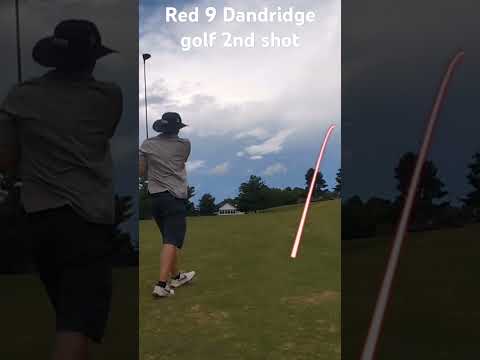
Red 9 Dandridge Golf albatross shot
Albatross on Red 9 at Dandridge: Golf’s Rarest Thrill
A hole-in-one on a par 3 gets the headlines, but the albatross — a 2 on a par 5 — is statistically rarer and arguably the greatest single-hole achievement in golf. This video captures an albatross shot on the 9th at Dandridge’s Red nine, and it is worth breaking down what has to go right for lightning like this to strike.
Every albatross starts with a decision: going for a par 5 in two. That takes a big drive and the courage to hit a long approach at a green built to repel it. Most albatrosses happen on reachable par 5s where the player had a clean lie, a number they trusted, and the commitment to swing aggressively at the flag instead of bailing to the safe side.
Setting Yourself Up for Your Own Albatross
You cannot plan an albatross, but you can create the conditions. First, know which par 5s on your course are genuinely reachable — if you cannot carry the trouble or the green is a fortress, lay up and live to fight. Second, when the stars align (great drive, good lie, comfortable yardage), commit to the aggressive line. Tentative swings do not make albatrosses.
Third, get your long game dialed. Fairway woods and hybrids are the albatross clubs, so practice them off tight lies until your contact is reliable. A flushed 3-wood from 230 that chases onto the green is the shot that makes these stories possible.
Most golfers will never make one — and that is what makes them magical. But every time you stripe a drive on a reachable par 5, you are buying a lottery ticket. Swing with conviction and enjoy the ride.
⛳️ Want more raw, unfiltered golf? Browse the full Shankers Blog — every shot, every round, no fluff.

Blue 9 Dandridge Golf Tee shot
Blue 9 at Dandridge: The Closing Tee Shot
The 9th on the Blue Course at Dandridge Golf and Country Club is a finishing hole — and finishing holes demand finishing tee shots. The video above shows the tee shot on Blue 9, the last swing of the front nine and the moment that decides how you make the turn.
Closing tee shots are a mental test. You’ve got a score going, you’re thinking about the turn, and the hole seems to get narrower. The best players treat the 9th tee like any other — same routine, same commitment, same target — because the hole doesn’t know it’s the last one.
Playing the Finishing Hole
Pick a conservative-aggressive target: the wide part of the fairway, not the corner that cuts the dogleg. On closing holes, position beats heroics. A ball in play gives you a full swing into the green; a ball in trouble gives you a story.
Manage the turn in your head. Whether you’re under par or over it, the 9th tee shot is just one swing. Don’t let the front-nine total change your club or your target — play the hole, not the score. The back nine is a fresh start either way.
Watch the video and see a proper closing tee shot: committed, on line, and in play. That’s how you make the turn with momentum — or at least with your dignity intact.
⛳️ Want more raw, unfiltered golf? Browse the full Shankers Blog — every shot, every round, no fluff.

Eagle Shot 136 yards Blue 4 Dandridge Golf
136 Yards to Glory: Playing the Eagle Approach on Blue 4
One hundred thirty-six yards. For most golfers that is a smooth 9-iron or a full pitching wedge — a scoring club, a green-light number. In the video above, it becomes something more: an eagle opportunity on Blue 4 at Dandridge, the kind of approach that turns a good hole into a story you tell for years. But 136 yards only becomes an eagle chance if you play it with intention.
The first decision is the target, and most amateurs get it wrong. They aim at the pin. The pin is four paces from the edge, the wind is moving, and suddenly a good swing finds a bunker. Better players aim at the fat part of the green and let the pin come to them — and on the rare day everything lines up, the ball chases toward the hole anyway. Eagle approaches are usually the result of a smart target and a pure strike, not a heroic one.
Own Your Stock 136
Distance control from 136 is about owning a number, not manufacturing one. Know exactly which club you hit 136 with a comfortable, full swing — not juiced, not eased off. That stock shot should be so grooved you could hit it half-asleep. If 136 falls between clubs, take the longer one and grip down half an inch; a controlled longer club beats a maxed-out shorter club for both distance control and spin.
Then commit to the flight. Pick your start line, visualize the ball’s entire journey — apex, descent, first bounce — and swing through the picture. The eagle shot in the clip works because there is zero hesitation in it. Doubt at 136 yards produces the chunked wedge or the bailed-out miss; commitment produces the shot of the day.
You will not eagle them all. But play every 136-yarder like this one, and the flag will start looking bigger.
⛳️ Want more raw, unfiltered golf? Browse the full Shankers Blog — every shot, every round, no fluff.
Ready to finally understand golf improvement without the headache? GolfLic.com is your dedicated source for free and easy golf lessons designed to deliver real results, fast. Forget the confusing theories and endless explanations – just clear, actionable advice and videos to get you swinging better and enjoying the game more. Explore our free lessons now and unlock your golfing potential at GolfLic.com!